Adobe
One of the best software businesses in the world has fallen to a bargain price because investors fear AI will destroy it. But a full year of actual results shows the opposite: AI is adding to sales, the harm is confined to one tiny part of the business, and the main business is still growing by more than 10% a year.
How we would trade it, in plain terms
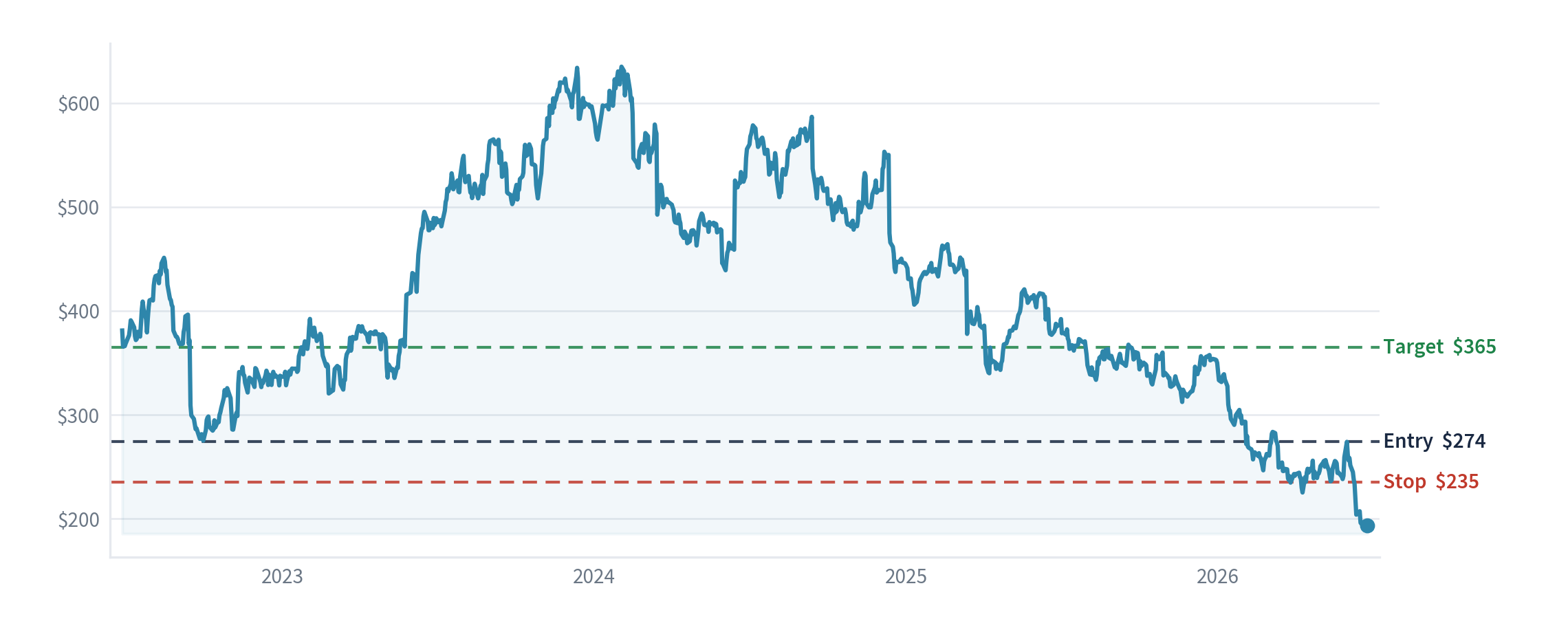
We would buy at the next day's closing price, about $274 a share, sell and take the loss if it fell to $235 (our "stop" — the line that says the idea isn't working), and aim for $365 over 12–18 months. That means risking about $39 a share to try to make about $91 — a bit over two-to-one. Confidence: 3.5 out of 5, kept below the top mark for two reasons: Adobe is changing its chief executive at the same time as AI is shaking up its industry, and it has genuinely lost one market — design software — to a rival called Figma.
What the company does
Adobe makes the software the creative and digital world runs on: Creative Cloud (Photoshop, Illustrator, Premiere — what designers, photographers and video editors use every day), Document Cloud (Acrobat and PDFs — the standard way the world shares documents) and Experience Cloud (the tools big companies use to run their marketing and websites). Almost all of it is sold by subscription, so the income is steady and very profitable — Adobe keeps about 45 pence of operating profit on every pound of sales.
The idea in one sentence
One of the best software businesses in the world has fallen to a bargain price because investors fear AI will destroy it. But a full year of actual results shows the opposite: AI is adding to sales, the harm is confined to one tiny part of the business, and the main business is still growing by more than 10% a year.
How shares like this usually behave
Here is our starting point. When a strong, hard-to-leave business is sold off on fear of AI, the fear is usually bigger than the real damage — and the shares tend to recover once people see the actual numbers don't match the scary headlines. That pattern only breaks in the minority of cases where the new technology genuinely and permanently replaces the old business. That is exactly the risk we have to weigh here, because Adobe has completely lost one market — the software designers use to lay out apps and websites. So the odds are on our side, but there is a real chance of being wrong.
Why it looks cheap
At about $274, Adobe's share price is roughly 12 times its expected yearly earnings (or about 15 times if you count every cost, the stricter way to measure it). That is strikingly cheap for a business this dominant and profitable. For comparison, other high-quality software firms cost far more for each pound of profit: Salesforce about 19 times, Intuit about 25, Autodesk about 29, Microsoft about 30. Adobe is the cheapest quality name in its neighbourhood by a wide margin.
It also generates more than $9bn of spare cash a year — the money left over after running and investing in the business — worth about 7% of the company's total stock-market value. And it genuinely reduces the number of its shares by buying them back (we check the count actually falls, rather than just cancelling out new shares handed to staff, which is the trick some firms use). Our case rests mainly on that cheap price and that cash.
What today's price assumes — and what we think it's worth
We model three possible futures over the next five years. In each we grow the earnings forward, then apply the price-to-earnings ratio we'd expect at the end, to get a fair value:
| Scenario | What we assume | Fair value in 5 years |
|---|---|---|
| Bad case (1-in-4) | Earnings stay flat and the price-to-earnings ratio falls to ~10 times (the AI damage is real) | ~$234 |
| Most likely (1-in-2) | ~10% earnings growth a year, the ratio edges up to ~15 times | ~$565 |
| Good case (1-in-4) | ~13% growth a year, the ratio rises to ~20 times as the AI fear fades | ~$862 |
Blending those three by how likely we think each is gives an expected return of about 13.5% a year, with a worst-case loss of about 15%. Put simply: at about 12 times earnings, the market is assuming Adobe barely grows at all — so we make good money even if the business merely holds steady, while still facing a real, measured downside if the AI pessimists turn out right.
What we think the market is missing
The bear case is one line: "AI will make Photoshop obsolete." A year of numbers says otherwise. Over the last four quarters sales grew 11%, 11% and 12%; total subscription income rose from $18.6bn to $26.1bn (about 11%); earnings per share grew from +14% to +19%, with profit margins around 45–47%. On AI specifically, Adobe is already making money from it: revenue from its Firefly AI tools grew 75% in a single quarter to more than $250m, AI usage jumped, and — tellingly — Adobe's Firefly is the leader in AI design tools, with about 29% of the market against Figma's roughly 2%. The market prices Adobe as a victim of AI; the evidence is that it is becoming a seller of it.
And the much-quoted line that "management admitted AI is eating its business" is really about just one product — its old stock-photo library. That is about $450m, roughly 2% of sales, and it knocks only about 0.3 of a percentage point off the growth rate. Management says the problem is confined to that one product, with no wider decline in Creative Cloud. A small, contained cut mistaken for a fatal wound.
Does the economic backdrop help or hurt?
Adobe sells worldwide to businesses and creative professionals, so demand follows the broad digital economy rather than any one country's ups and downs. Falling US interest rates would help a cash-rich software business whose value comes mostly from profits far in the future (and rising rates would hurt it). Because Adobe earns in US dollars, the dollar-to-pound exchange rate affects what we make in pounds. The force that really decides this one is technology (AI), not the economy.
Why we think there's an edge
This is a quality business at a discount: a company with strong, durable defences against competitors (a "moat") that has been marked down on a fear its results don't yet show. The clearest supporting evidence is in how it spends its cash — a genuine buyback that actually cuts the share count, done while the shares are cheap, which builds value far faster than buying them back when they're expensive. This works whichever way the AI debate ends: even if growth merely holds steady, cheap shares plus buybacks do the job. We make no claim that insiders are buying — we haven't found evidence of that.
What other real-world signals show
The outside, real-world signals point both ways. Against Adobe: Figma is poaching senior Adobe staff (reportedly paying 35–67% more), and Adobe made layoffs in 2026 in its Creative and Document teams — real competitive pressure and cost-cutting. For Adobe: the number of people using its free creative apps passed 80 million, up 50% on a year earlier, and monthly users of Acrobat and Express grew about 20% — a healthy stream of free users it can later turn into paying customers. (A fuller sweep of this kind of data is still to come.)
The checklist we run every idea through
- How profitable, and how protected — industry-standard tools, ~45% operating margins, and customers who build their daily work around Adobe and find it painful to switch away.
- What it does with its cash — large, steady buybacks that genuinely cut the share count, now at a cheap price; watch the ~$1.9bn purchase of Semrush as a test (a shift toward buying other companies, not just buying back its own shares).
- Cushion if we're wrong — ~12 times earnings for a business growing ~10% at 45% margins; the gap to rivals at 19–30 times is the safety margin.
- Are the profits real cash? — yes; almost all of the reported profit turns into actual cash.
- Is it financially solid? — more cash than debt; no risk of failure on the balance sheet.
- Where we differ, and how we could lose — the market expects AI to destroy Adobe; the numbers show AI adding to it so far. We lose if AI genuinely erodes Creative Cloud (not just the stock-photo corner).
- Are managers aligned with shareholders? — long-tenured management, though a change of chief executive is under way (below). No insider-buying claim made.
Management: do they do what they say?
A strong record, with a fresh question mark. Over the last year of results, Adobe set its targets and hit them, widened its profit margins, and met or beat its own goals for AI adoption — they do what they say. The new uncertainty: in March 2026, long-serving chief executive Shantanu Narayen said he will step up to Chairman once a replacement is chosen (the front-runner is David Wadhwani, though it could be an AI specialist hired from outside). Analysts at Barclays and BMO blame part of the recent share-price fall on the uncertainty over who will take over. A change of boss while AI is reshaping the industry is a genuine thing to watch — but not a reason to walk away.
What would make us wrong
The real risk is the idea itself, not the price. If AI rivals genuinely win customers away from Creative Cloud (Figma already owns 80–90% of the design-software market Adobe was blocked from buying; Canva has 260m+ users at the cheaper end; Anthropic has launched a rival to Adobe Express) and subscription growth slows toward low-single-digit percentages, then the cheap price is deserved — the shares aren't a bargain after all. A run of poorly judged, overpriced takeovers, or a messy change of chief executive, would also hurt. Our discipline: we sell at $235 (about 14% below entry), roughly where "AI is really hurting the core business" would be winning the argument.
What we'll watch to check we're right
- Subscription growth stays above 10% through Adobe's 2026 financial year (its own guidance is ~10%).
- Firefly's AI income keeps growing fast (it was up 75% in a single quarter, past $250m).
- The core Creative Cloud keeps adding new subscription income (unlike the shrinking stock-photo corner).
- A permanent chief executive is named, with a credible plan, during 2026.
- What would make us give up: growth slowing to low single figures, Creative Cloud subscriptions starting to shrink, or a big overpriced acquisition — any of those and we'd downgrade or drop it.
- What would make us re-check the whole case: each quarter's results, the new-CEO announcement, any major takeover, or fresh data on Figma/Canva taking share.
Sources: Adobe's results announcements and investor calls for its last three quarters and its latest quarterly regulatory filing; recent analyst notes (including the Mizuho and Jefferies downgrades); the financial figures Adobe files with the US regulator; and market prices for Adobe and its rivals. Figures are approximate and for context, not advice.
Part of an open research-framework experiment — generic research, not a personal recommendation and not advice. The entry, stop and target are the framework's own tracked levels, not instructions or predictions for you. The book is hypothetical (notional money, no trades placed); capital is at risk and past or hypothetical performance is not a reliable indicator of future results. Portfolio Lab is not FCA-authorised. Disclosures & risk →