American Express
A genuinely high-quality business — affluent customers, a trusted brand, mid-teens earnings growth, and Warren Buffett's largest long-held stake — is available at a sensible price, and quality bought at a fair price tends to compound steadily.
How we would trade it, in plain terms
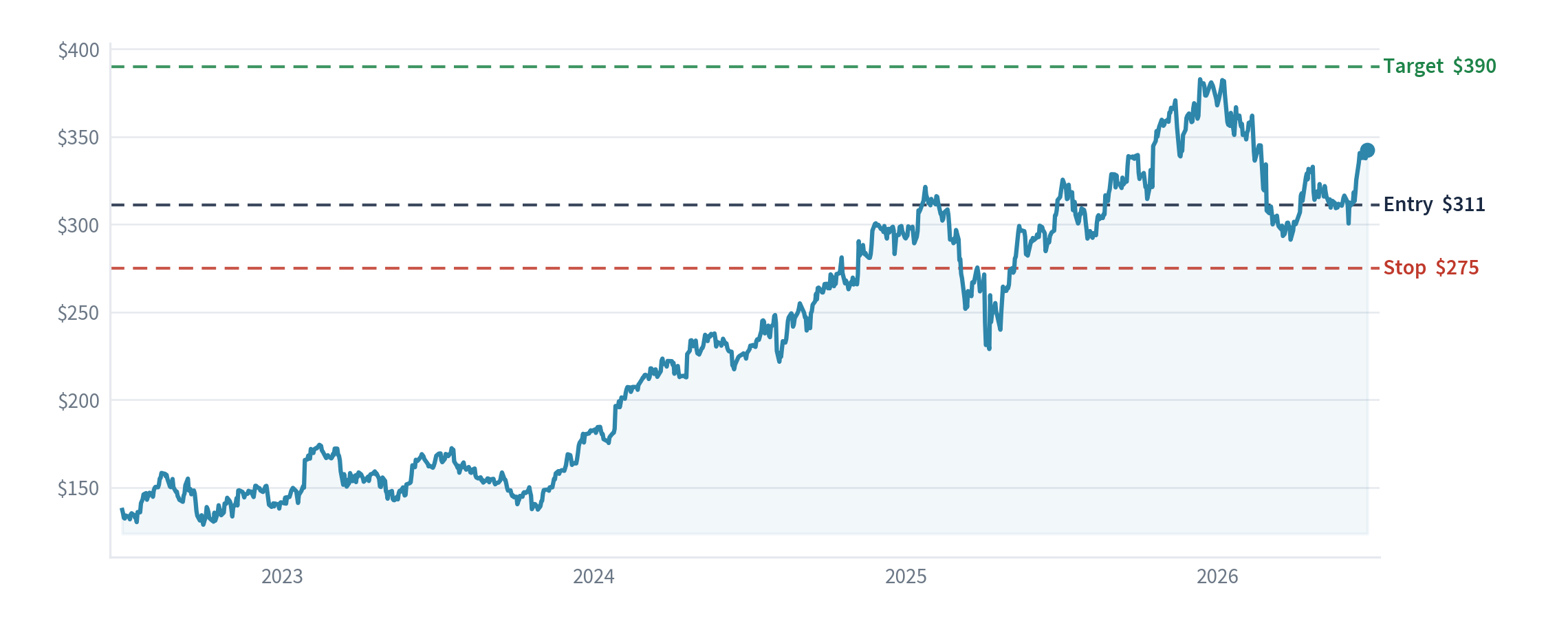
We would buy at the next day's closing price, about $311 a share, sell and take the loss if it fell to $275 (our "stop" — the line that says the idea isn't working), and aim for $390 over 12–18 months. That means risking about $36 a share to try to make about $79 — about 2.2 to one. Confidence: 3.5 out of 5, held below the top mark for two reasons: the shares are good value rather than outright cheap, and card spending is sensitive to the economy.
What the company does
American Express runs a premium card and payments network aimed at higher-spending, more affluent people and businesses. It earns money three ways: a small slice of everything its cardholders spend (the fee merchants pay to accept the card), the annual fees on its premium cards, and interest on the balances some customers carry. Crucially it runs a closed loop — it both issues the cards and runs the network — so it sees its customers' spending directly and can reward them to spend more.
The idea in one sentence
A genuinely high-quality business — affluent customers, a trusted brand, mid-teens earnings growth, and Warren Buffett's largest long-held stake — is available at a sensible price, and quality bought at a fair price tends to compound steadily.
How shares like this usually behave
Here is our starting point. A high-quality business bought at a fair price — not a bargain — usually returns roughly what its earnings grow, rather than getting an extra boost from the rating rising (the market paying more for each pound of profit). So the realistic prize here is steady mid-teens compounding, not a quick re-rating. That sets a sober expectation: the business does the work, and we shouldn't lean on the market suddenly paying more for it.
Why it looks fairly priced
On the company's own guidance (about $17.60 of earnings per share this year), American Express at about $314 trades at roughly 18 times earnings. That sits sensibly between the two kinds of business it straddles: Visa costs about 29 times earnings and Mastercard about 31 (pure payment networks), while large banks like JPMorgan cost about 12–13 (pure lenders). Amex is part-network, part-lender, so a price in between is fair — but it is growing earnings in the mid-to-high teens, like the networks, not like a bank. Network-like growth at well below network prices is the opportunity. This is not a deep bargain; it is quality at a fair price, and it steadily buys back its own shares, genuinely reducing the share count over time.
What today's price assumes — and what we think it's worth
We model three possible futures over the next five years. In each we grow the earnings forward, then apply the price-to-earnings ratio we'd expect at the end, to get a fair value:
| Scenario | What we assume | Fair value in 5 years |
|---|---|---|
| Bad case (1-in-4) | A consumer recession hits affluent spending and credit at once; earnings stall and the rating slips to ~14 times | ~$265 |
| Most likely (1-in-2) | Mid-teens earnings growth continues and the rating holds near ~18 times | ~$551 |
| Good case (1-in-4) | Growth stays strong and the rating edges up toward ~22 times | ~$739 |
Blending those three by how likely we think each is gives an expected return of about 10.8% a year, with a worst-case loss of about 15.5%. That downside is larger than in our cheaper ideas — precisely because the shares are fairly, not cheaply, priced, so there's less of a cushion if a recession hits.
What we think the market is missing
The worry that holds the price down is the credit cycle — the fear that in a downturn cardholders stop spending and stop paying. Amex's answer is its customer base: skewed wealthy, so spending and repayment hold up far better than at a mass-market lender. The numbers bear this out — through early 2026, the share of balances paid late and written off was low and falling (late payments around 1.2%, write-offs around 2.1%), and management called credit quality "excellent." The growth engine is also younger than people assume: spending by customers in their twenties and thirties is its fastest-growing, and more than 70% of new accounts are fee-paying premium cards, which locks in recurring fee income. When a rival raised the stakes — Chase overhauled its top card with an ~$795 fee — Amex met it: its own card-fee revenue grew 16%, its fastest-growing line, with customer retention steady after its own fee rise. The premium model is working, not cracking.
Does the economic backdrop help or hurt?
American Express lives on consumer and business spending — especially travel, dining and luxury — so a strong consumer helps and a recession hurts; the cushion is the affluent base. Spending outside the US has grown by more than 10% a year for 20 quarters in a row, adding a second engine. The direction of US interest rates matters because it funds the lending side, and because Amex earns in US dollars, the dollar-to-pound exchange rate affects what we make in pounds.
Why we think there's an edge
This is a quality compounder at a fair price. The durable advantage is the closed-loop network plus a premium brand that lets Amex charge annual fees rivals can't. The clearest supporting evidence is in how it spends its cash — a genuine buyback that actually reduces the share count (the test we insist on), plus a growing dividend. Warren Buffett's two-decade stake of around 22% is supporting context, not the case — and we've shown elsewhere that blindly copying even great investors mostly captures their style, not their skill, so we lean on the business, not the famous name behind it.
What other real-world signals show
The outside signals are, fittingly, a pure valuation debate: one major broker (BofA) is a buyer with a target around $420, while another (BTIG) rates it sell around $285 — purely on price, not on the business. That split is exactly our "quality at a fair, not cheap, price" framing. Tellingly, Buffett's stake percentage keeps rising without him buying a share — simply because the buyback keeps shrinking the count, which proves the buyback is real. (A fuller sweep of this kind of data is still to come.)
The checklist we run every idea through
- How profitable, and how protected — closed-loop network, premium brand, affluent base; about 32% return on the shareholders' money, and pricing power in annual fees few rivals can match.
- What it does with its cash — steady buybacks that genuinely cut the share count, plus a growing dividend.
- Cushion if we're wrong — about 18 times earnings for mid-to-high-teens growth (a fair price-to-growth balance); reasonable rather than deeply cheap — said honestly.
- Are the profits real cash? — earnings are high quality; note that "spare cash flow" isn't a meaningful gauge for a lender, so we lean on earnings, return on equity and spending growth instead.
- Is it financially solid? — a regulated, well-capitalised lender; the real risk is the credit cycle, not failure.
- Where we differ, and how we could lose — the market prices credit-cycle risk; we think the affluent, fee-paying base makes it more durable. We lose if a sharp recession hits spending and credit together.
- Are managers aligned with shareholders? — Buffett's long-held large stake aligns with owners; no open-market insider-buying claim is made.
Management: do they do what they say?
A strong record. Chief executive Steve Squeri — in post since 2018 and a 40-year Amex veteran — has set and reaffirmed medium-term targets (around 10% revenue growth and mid-teens earnings growth) and delivered them; his premium-card bet (the roughly $900 Platinum) paid off, and the total return to shareholders has beaten JPMorgan, Visa and the wider market. The latest quarter delivered 11% revenue and 18% earnings growth, and full-year guidance was reaffirmed. The tone is specific and consistent, not promotional.
What would make us wrong
A genuine consumer recession that hits card spending and credit quality at the same time would break the near-term case — and because the shares are fairly, not cheaply, priced, there's less cushion than in a deep-value idea. A lasting shift away from premium cards, or fee fatigue among younger customers, would also hurt. Our discipline: we sell at $275 (about 11% below today's price).
What we'll watch to check we're right
- Card-fee revenue keeps growing by more than 10% a year with retention steady — it grew 16% last quarter.
- Credit stays benign — late payments and write-offs low and stable.
- Spending by younger and international customers keeps leading the growth.
- The buyback keeps shrinking the share count.
- What would make us give up: a real consumer downturn hitting spending and credit together, or clear fee fatigue among younger customers — either of those and we'd downgrade or drop it.
- What would make us re-check the whole case: each quarter's results, the credit-quality figures, and any sign the premium-card model is losing its pull.
Sources: American Express's results announcements and investor call for its latest quarter and its reaffirmed 2026 guidance; its monthly credit-quality figures; recent analyst notes on both sides; the financial figures it files with the US regulator; and market prices for American Express, Visa and Mastercard. Figures are approximate and for context, not advice.
Part of an open research-framework experiment — generic research, not a personal recommendation and not advice. The entry, stop and target are the framework's own tracked levels, not instructions or predictions for you. The book is hypothetical (notional money, no trades placed); capital is at risk and past or hypothetical performance is not a reliable indicator of future results. Portfolio Lab is not FCA-authorised. Disclosures & risk →