Copart
One half of a hard-to-replicate auction duopoly, riding a decades-long tailwind — more and more crashed cars are written off rather than repaired — is going through a short-term volume dip, and that dip is the reason you can buy it at a sensible price.
How we would trade it, in plain terms
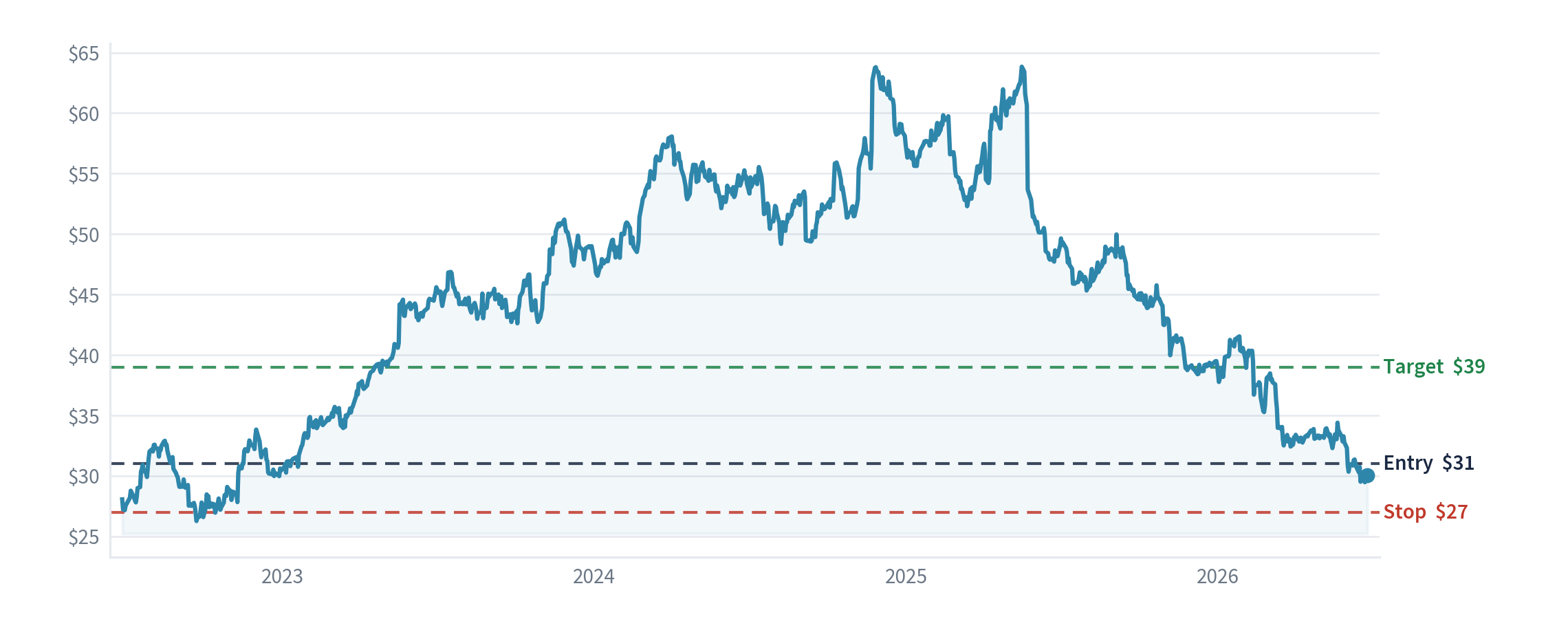
We would buy at the next day's closing price, about $31 a share, sell and take the loss if it fell to $27 (our "stop" — the line that says the idea isn't working), and aim for $39 over 12–18 months. That means risking about $4 a share to try to make about $8 — roughly two-to-one. Confidence: 3 out of 5, deliberately modest, because growth has slowed in the short term, the shares aren't cheap on this year's profit, and a strengthening rival is taking some share.
What the company does
Copart runs the world's biggest online auction for written-off and damaged cars. When an insurer declares a crashed car a "total loss", Copart auctions it to a global pool of buyers (breakers, rebuilders, dealers) and takes a fee from both sides. It owns the land and the technology, and the two-sided marketplace — more cars attract more buyers, which attracts more cars — is very hard to copy. It is effectively a duopoly (with IAA, now part of RB Global), earns about 36% operating margins, and sits on net cash (no debt).
The idea in one sentence
One half of a hard-to-replicate auction duopoly, riding a decades-long tailwind — more and more crashed cars are written off rather than repaired — is going through a short-term volume dip, and that dip is the reason you can buy it at a sensible price.
How shares like this usually behave
Here is our starting point, and it's two-sided. Auction-duopoly businesses with network effects tend to compound well over time, which favours us. But there is a cautionary pattern too: when a strengthening number-two starts winning back share from the incumbent, it can cap the leader's growth for a while — and that is exactly the live question here. So the quality earns the benefit of the doubt, while the competitive threat keeps our conviction at a measured 3.
Why it looks reasonably priced
Copart trades at about 20 times earnings. For a net-cash business earning 36% margins in a duopoly, that is reasonable rather than cheap — and notably below where it has often traded. The support is the balance sheet and the structural driver rather than a low price: it has no debt (so no interest-rate risk to its finances), turns profit into cash, and rides a trend that has run for years — the share of crashed cars written off rather than repaired (the industry calls it "total-loss frequency") has risen to about 23.6%, up nearly five percentage points in four years, because cars are now so expensive to fix that insurers write more of them off. Every written-off car is a car for Copart to auction. And — correcting an earlier impression — Copart is returning cash: it repurchased more than $1.6bn of its own shares this financial year, alongside its roughly $4.2bn of net cash.
What today's price assumes — and what we think it's worth
We model three possible futures over the next five years. In each we grow the earnings forward, then apply the price-to-earnings ratio we'd expect at the end, to get a fair value:
| Scenario | What we assume | Fair value in 5 years |
|---|---|---|
| Bad case (1-in-4) | The rival keeps taking share, the write-off trend plateaus, and US volumes stay soft | ~$27 |
| Most likely (1-in-2) | The soft patch passes, the write-off trend and international growth resume, the rating holds near ~20 times | ~$50 |
| Good case (1-in-4) | Volume re-accelerates and the pricing power plus write-off tailwind compound | ~$74 |
Blending those three by how likely we think each is gives an expected return of about 8.8% a year, with a worst-case loss of about 11%. Quality, but a fair (not cheap) price plus the competitive question keep this a 3, not a top pick.
What we think the market is missing
The recent numbers look dull — revenue up just 2%, US insurance volumes actually down about 4% — and the market is extrapolating that softness. We think most of it is explainable and moderating. As insurance premiums rose, more drivers dropped to cheaper, damage-only cover, which means fewer comprehensive claims and so fewer total-loss cars — a one-off shift in the mix, not lost customers — and the US decline has already improved from about −7% to about −3% over recent quarters, while pricing per car stayed strong (up about 8%). Copart is also growing fast abroad (units up about 6%, revenue up about 14% internationally, led by the UK, Germany and Canada).
We are honest about the one genuine negative: the rival, RB Global's IAA, grew its volumes around 9% for three straight quarters and is clawing back share (back toward 35% of the market, from a low ebb), with a major insurer reportedly shifting some volume to it. So the soft patch is partly a cyclical mix-shift and partly some share loss to a reinvigorated competitor — both true. That's why this is a measured 3.
Does the economic backdrop help or hurt?
Copart's volumes track how much people drive and how often they crash (cyclical, currently soft) and, more importantly, the steady rise in the share of cars written off (a long tailwind). Used-car and scrap prices affect the value of what it auctions. The net-cash balance sheet means interest rates don't threaten its finances. Because it earns mostly in US dollars, the dollar-to-pound exchange rate affects what we make in pounds, though the growing international arm adds some currency variety.
Why we think there's an edge
This is a quality compounder at a fair price during a soft patch. The durable advantage is a genuine network-effect moat (the two-sided marketplace) and a pristine balance sheet, on top of a multi-decade structural driver (the rising write-off rate). These are independent of the near-term volume dip. It reached us through a respected quality investor's holdings, but the case rests on the business, not on whose holdings it appeared in. No insider-buying claim is made.
What other real-world signals show
The signals are cautious, consistent with the soft patch. Analysts trimmed their price targets (from around $49 toward $42) on the volume miss and on competition over fee rates, the consensus is a "hold," and short-selling is modest (around 3%). The key external fact to watch is the rival's share gains above — genuine, and the main thing that could turn a passing dip into a lasting problem. (A fuller sweep of this kind of data is still to come.)
The checklist we run every idea through
- How profitable, and how protected — a two-sided-marketplace network effect, a duopoly, about 36% margins, and high returns on capital.
- What it does with its cash — net cash, reinvests in land and technology and international growth, and now buying back stock (more than $1.6bn this year).
- Cushion if we're wrong — about 20 times earnings is reasonable (not cheap) for the quality; the cushion is the net-cash balance sheet plus the write-off tailwind, bought during a soft patch.
- Are the profits real cash? — yes; strong, clean cash conversion.
- Is it financially solid? — net cash, no debt — about as safe as it gets.
- Where we differ, and how we could lose — the market extrapolates the volume dip; we see mostly a mix-shift over a structural uptrend. We lose if the write-off trend plateaus, US volumes stay soft, and the rival keeps taking share.
- Are managers aligned with shareholders? — founder-shaped, long-term culture; no open-market insider-buying claim made (and we note the chief executive trimmed his own stake last year).
Management: do they do what they say?
A strong record. Copart has compounded for decades under a stable, founder-shaped culture — the founder, Willis Johnson, is chairman, and the chief executive, Jeff Liaw, "thinks like an owner" — with consistent margins, net cash throughout, and disciplined international expansion. It tends to under-promise (it gives little formal guidance) and let results speak; the latest quarter showed the US softness honestly while international growth offset it.
What would make us wrong
If the long-run rise in the write-off rate stalls and US volumes stay depressed and the rival keeps taking share, growth flatlines and 20 times earnings is no bargain. A sharp fall in used-car values would also hurt. Our discipline: we sell at $27 (about 13% below entry).
What we'll watch to check we're right
- The US volume decline keeps narrowing (it has improved from about −7% to about −3%).
- Pricing per car stays strong (it was up about 8%).
- The write-off trend holds around its multi-year uptrend (~23.6% and rising).
- The rival's share gains — whether IAA keeps clawing back ground.
- What would make us give up: the rival keeps taking share and the write-off trend plateaus — that combination and we'd downgrade or drop it.
- What would make us re-check the whole case: each quarter's volumes and pricing, and any further sign of insurers shifting work to the competitor.
Sources: Copart's results announcements and investor calls for its recent quarters; its share-buyback and balance-sheet disclosures; industry reporting on the competing auction business (RB Global / IAA); the financial figures it files with the US regulator; recent analyst notes; and market prices. Figures are approximate and for context, not advice.
Part of an open research-framework experiment — generic research, not a personal recommendation and not advice. The entry, stop and target are the framework's own tracked levels, not instructions or predictions for you. The book is hypothetical (notional money, no trades placed); capital is at risk and past or hypothetical performance is not a reliable indicator of future results. Portfolio Lab is not FCA-authorised. Disclosures & risk →