FTI Consulting
The shares fell on one weak division while the most important division is speeding up — and three of the company's most senior people bought shares with their own money at the lows.
How we would trade it, in plain terms
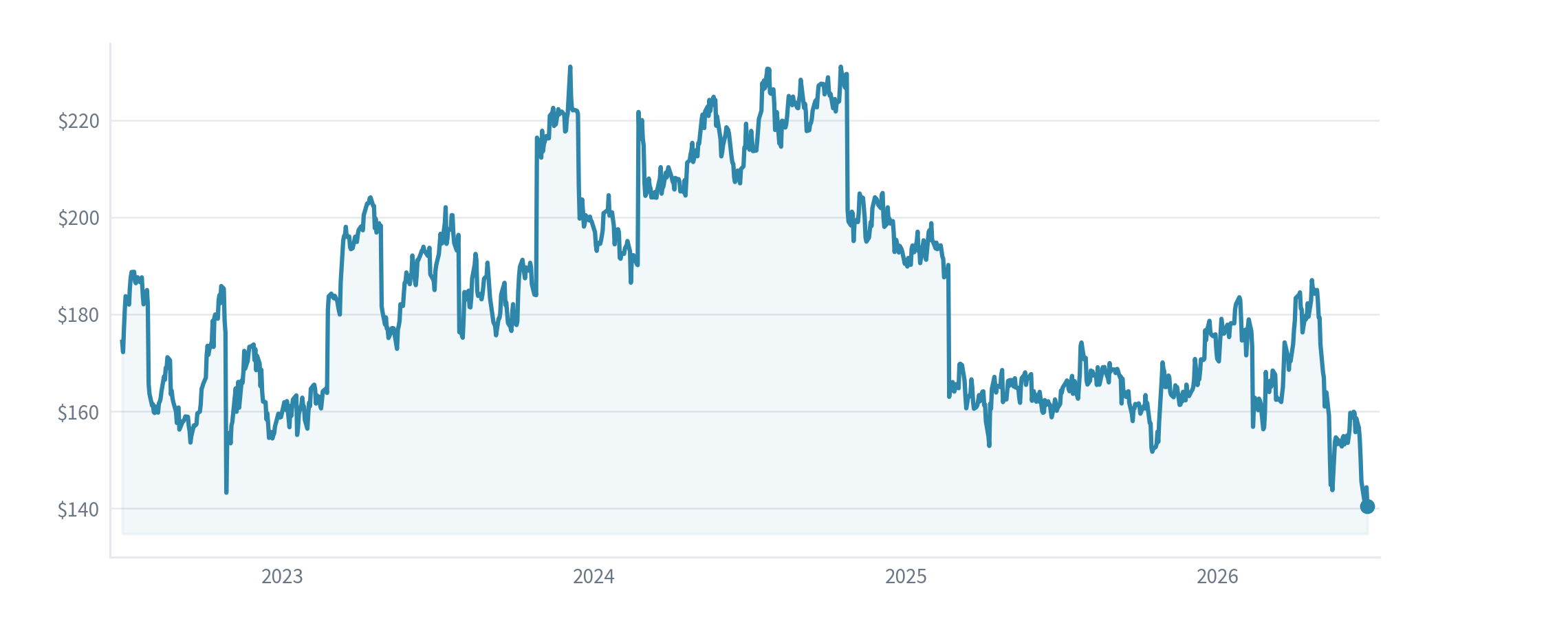
The thesis is strong, but the price has run away from us. We would only buy on a pullback to $146 (using a limit order — an instruction to buy only at or below that price), which is roughly where the company's own executives bought. The shares have since risen to about $153, and chasing them there spoils the balance of risk and reward — so for now this one waits on the bench, and may not get filled. If we did buy at $146, we'd sell and accept the loss at $132, with a goal of $185 — about $39 of potential gain against $14 of risk, close to 3 times as much upside as downside. Confidence: 2 out of 5. On the bull case alone we'd have rated the idea about 4 out of 5, but the test below changed our mind — so we have downgraded it (see "is the weakness cyclical or company-specific?").
What the company does
FTI Consulting is a specialist advisory firm — the people companies call in for complicated, high-stakes problems. It has four main areas: corporate finance and restructuring (helping companies in financial difficulty or doing big deals), economic and antitrust consulting (expert analysis for competition cases and mergers), strategic communications, and forensic/dispute work. It sells expertise and people-hours, and it's a genuinely profitable, cash-generating business.
The idea in one sentence
The shares fell on one weak division while the most important division is speeding up — and three of the company's most senior people bought shares with their own money at the lows.
The set-back, and how big it was
When FTI reported its first-quarter 2026 results in early May 2026, profit came in below expectations and the shares dropped to near their 52-week low, around $140. That disappointment is what created the opportunity.
Why we think the disappointment is misleading
The shortfall came from one division — economic and antitrust consulting, whose workload rises and falls with the pace of mergers and competition cases, and which had a quiet quarter. But the company's largest division — corporate finance and restructuring — is accelerating (its profit jumped sharply and its revenue rose about 19%), and management kept its full-year forecast unchanged. In other words, one cyclical part dipped while the engine room got stronger; the market treated a temporary, one-part wobble as if the whole firm were weakening.
On valuation, in fairness, FTI isn't a bargain — it trades at roughly 14 times next year's expected profit, about typical for a good consulting firm. So cheapness is not the argument here; the argument is the misread earnings dip plus the signal below.
The signal we are acting on
On 13 May 2026, three of FTI's most senior people — the chief executive, the chief financial officer and the chief strategy officer — bought shares on the open market with their own money, around $144, near the 52-week low. As elsewhere, a cluster of senior insiders buying together is a far more reliable sign than any one person, and it's a signal we deliberately track.
The crucial test: is the weakness cyclical or company-specific? (This is why we downgraded it.)
The whole bull case rests on the economic-consulting slump being a temporary lull in the deal and antitrust cycle. We tested that two ways. First, the cycle itself: mergers and acquisitions are clearly recovering (large-company deal activity rose about 37% in 2025 and the momentum has carried into 2026) — so on that measure, demand should be improving, which would support FTI.
But the second test is more telling, and it goes the other way. We looked at the closest listed pure-play rival, Charles River Associates, whose business is almost entirely economic and antitrust consulting. In early 2026 it reported record revenue, and its antitrust practice hit an all-time quarterly high — it is hiring aggressively to keep up with demand. In other words, the part of the industry where FTI shrank is booming for its nearest competitor. That strongly suggests FTI's decline is company-specific — losing share or an execution problem — not a cyclical dip the whole industry is sharing. That is the bear case, not the bull case.
Where this leaves us
We are downgrading FTI to 2 out of 5 and taking it off the shortlist. The insider cluster is still a genuine, encouraging signal — the people who run the company are buying — but the central reason to be optimistic (a temporary, cycle-driven dip) is contradicted by the best evidence we can find. We'd want to see FTI actually win back business in economic consulting before acting. If we ever did buy (only on a pullback to ~$146), we'd exit at $132. (A separate press mention of a "$140m bet" on FTI is just a fund disclosing a long position — not a takeover, and it changes nothing.)
Sources: FTI's first-quarter 2026 results and earnings call; the insider share-purchase filings (13 May 2026).
Part of an open research-framework experiment — generic research, not a personal recommendation and not advice. The entry, stop and target are the framework's own tracked levels, not instructions or predictions for you. The book is hypothetical (notional money, no trades placed); capital is at risk and past or hypothetical performance is not a reliable indicator of future results. Portfolio Lab is not FCA-authorised. Disclosures & risk →