Games Workshop
One of the highest-quality businesses on the London market — it owns a beloved fictional universe and prints money from it — is about to push on three doors at once (a new game edition, easier ways in, and Amazon film/TV), any of which could widen its audience.
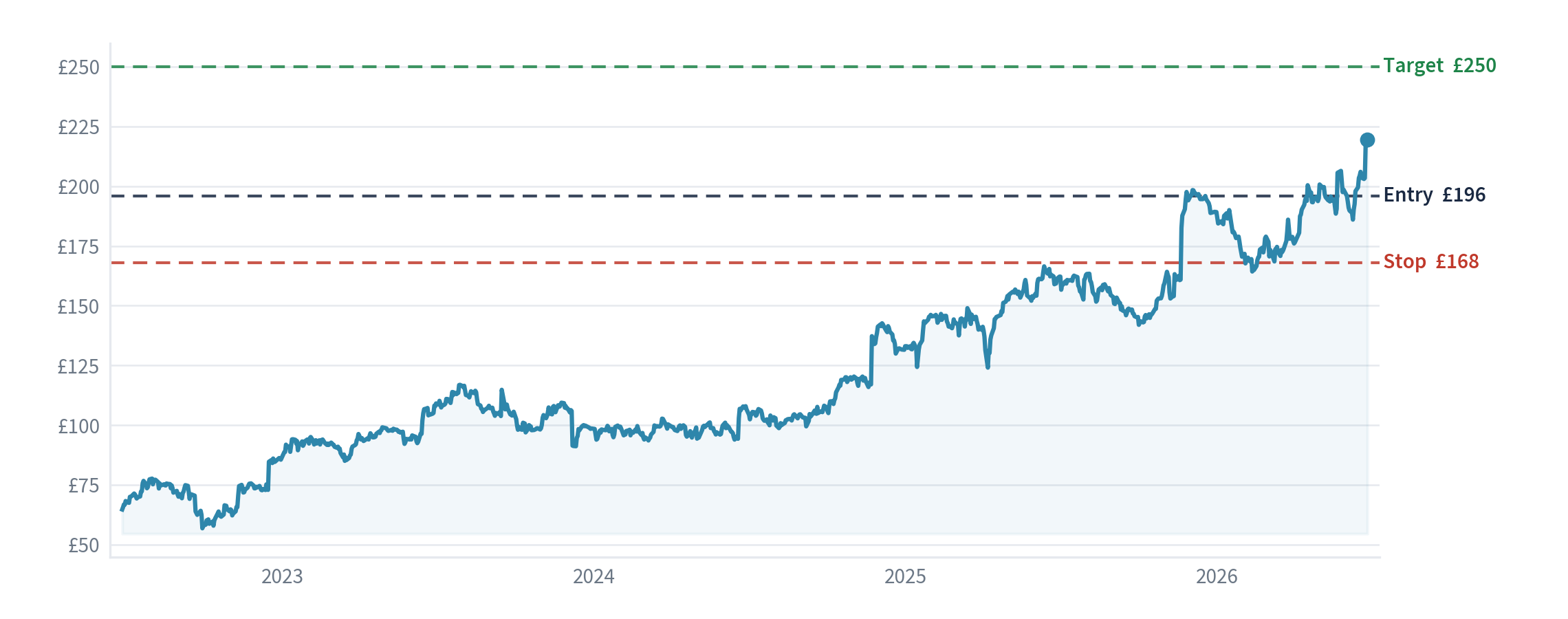
How we would trade it, in plain terms
We would buy at the next day's closing price, about £196 a share, sell and take the loss if it fell to £168 (our "stop" — the line that says the idea isn't working), and aim for £250 over 12–18 months. That means risking about £28 a share to try to make about £54 — roughly two-to-one. Confidence: 3.5 out of 5, held back because (see below) this is the most expensive share on our whole list — we're paying up for quality and a set of catalysts, not buying a bargain. A plus for a UK investor: it's pounds-listed, so no currency drag on the holding.
What the company does
Games Workshop designs, makes and sells Warhammer — the miniature figures, paints and rulebooks for its tabletop games (Warhammer 40,000 and Age of Sigmar). Crucially, it owns the fictional universe and makes the product itself in Nottingham, selling through its own shops, independent retailers and online. Its customers are famously devoted and keep buying year after year — which is why it earns enormous returns on the money it puts to work and carries no debt.
The idea in one sentence
One of the highest-quality businesses on the London market — it owns a beloved fictional universe and prints money from it — is about to push on three doors at once (a new game edition, easier ways in, and Amazon film/TV), any of which could widen its audience.
How shares like this usually behave
Here is our starting point, and it cuts both ways. The usual long-run outcome for a business like this — an owner of beloved intellectual property that compounds for years — is excellent. But the usual outcome from buying any share at about 32 times earnings while this year's profit is flat is poor: when so much is already in the price, a single disappointment can take the shares down a long way. So here it is the valuation, not the business, that sets our caution — which is exactly why we'd treat a pullback as a gift.
Why it is expensive — said plainly
We won't pretend this is cheap. On about £6 of earnings per share, Games Workshop at about £196 trades at roughly 32 times earnings — the richest price on our entire list, and dearer than several names we rejected for being too expensive. This year tells a mixed story: core sales grew a strong ~11% to about £625m, but profit was roughly flat (~£265m) because the lumpy, high-margin licensing income fell (from £52.5m to about £30m). So on this year's numbers there is no margin of safety — and we say so. What you're paying for is (a) a genuinely exceptional, IP-owning, high-return, no-debt compounder with strong pricing power, and (b) the Amazon option below. A pullback would meaningfully improve the entry.
What today's price assumes — and what we think it's worth
We model three possible futures over the next five years. In each we grow the earnings forward, then apply the price-to-earnings ratio we'd expect at the end, to get a fair value:
| Scenario | What we assume | Fair value in 5 years |
|---|---|---|
| Bad case (1-in-4) | The high rating de-rates before the upside shows, and hobby spending slows; earnings grow slowly off a flat year | ~£133 |
| Most likely (1-in-2) | Steady compounding plus the edition wave, with the rating easing only modestly | ~£229 |
| Good case (1-in-4) | An Amazon hit and a wider audience re-accelerate growth, and the rating holds | ~£370 |
Blending those three by how likely we think each is gives an expected return of about 5.6% a year — the lowest in our pool — with a worst-case loss of about 32%, the worst in our pool. That single line is the whole "great business, valuation is the risk" story in numbers: the quality is real, but at 32 times earnings you are exposed if anything disappoints. Best bought on a pullback.
What we think the market is missing — a stack of catalysts
The price treats this as a great-but-mature compounder. We think it is about to widen its funnel, through three catalysts that point the same way:
- A new game edition — June 2026 (near-term, dated). Warhammer 40,000's 11th edition launches in June 2026 (pre-orders early June, in shops from 20 June) with a new starter set. Edition refreshes are a reliable sales wave as the devoted base re-buys the new rulebooks and army kits — though, because of the company's May year-end, much of the benefit lands in the following financial year.
- Easier to start. The new starter set uses push-fit ("easy-build") models, and the company has confirmed pre-painted terrain. This lowers the assembly barrier for newcomers. We're careful here: Games Workshop is not moving to pre-painted figures (that would eat into its high-margin paint sales), so this widens the on-ramp modestly — easier building, not the removal of painting altogether.
- Amazon film/TV — the long option. Exclusive rights have gone to Amazon for Warhammer 40,000 films and television (with a fantasy option and merchandising to follow). A hit show drives mass awareness, and the easier on-ramp is what converts that awareness into paying hobbyists who then spend for years.
The point is the combination: a near-term demand wave, a gentle audience-widener, and an awareness engine — each independent, all pointing the same way. The downside on the Amazon and accessibility moves is small; the upside is large and not yet in the price.
Does the economic backdrop help or hurt?
Spending on the hobby is discretionary, so a deep consumer downturn would slow new-customer growth — though the existing base is unusually loyal and keeps spending, which cushions it. It is pounds-listed (no currency drag for our book), but its biggest single market is the US, so a much weaker dollar would dent reported sales, and US import tariffs recently knocked about £16m off profit.
Why we think there's an edge
Exceptional quality plus a stack of catalysts. The durable advantage is a wide moat — owned intellectual property, making its own product, real pricing power, and a devoted, repeat-buying base. On top sit three independent catalysts (the June edition, the easier on-ramp, and the Amazon deal). We are explicit that the margin-of-safety test is the weak link: at 32 times earnings there isn't one on current profit, so this idea leans on quality and catalysts, not a cheap price. No insider-buying claim is made.
What other real-world signals show
The signals confirm both the quality and the near-term stall. Ownership is high-quality and steady (84 institutions, with Baillie Gifford the largest at about 13%), and there's no short-selling crowd. But coverage is thin, the typical analyst target is only about 9% above today, and City brokers expect a rare profit dip this year (an empty major-launch slate) with re-acceleration next year on the edition wave — so the catalyst is a next-year story. There's also friction at the edges: recent price rises have met fan pushback (a price "boycott" even reached the financial press), testing the pricing power that underpins the whole model. (A fuller sweep of this kind of data is still to come.)
The checklist we run every idea through
- How profitable, and how protected — among the best anywhere: owned intellectual property, it makes its own product, real pricing power, fanatical repeat customers; very high returns on capital, net cash.
- What it does with its cash — exemplary: returns surplus cash as regular dividends (about £4.85 a share this year), no empire-building, no debt.
- Cushion if we're wrong — the weak point: about 32 times earnings with flat profit this year means none on current earnings. The cushion is qualitative (business quality plus the cheap Amazon option), not the price.
- Are the profits real cash? — pristine; profit converts to cash and is paid out.
- Is it financially solid? — net cash, no debt.
- Where we differ, and how we could lose — we think the option on a mainstream Warhammer hit is underpriced. We lose if the rating compresses (very possible at 32 times) before the Amazon upside shows, or if hobby spending slows.
- Are managers aligned with shareholders? — founder-shaped, shareholder-friendly culture; the chief executive reinvests his own dividends into the shares. No wider insider-buying claim made.
Management: do they do what they say?
A strong record. Chief executive Kevin Rountree (in post since 2015, 27 years at the company) runs one of the most candid, disciplined managements on the UK market — plain trading statements, no spin, surplus cash returned rather than hoarded or wasted, returns on capital around 29%, and a long record of compounding core sales. The latest update was characteristically straight: strong core growth, an honest flag on the lumpy licensing line.
What would make us wrong
The clearest risk is the one we've flagged: a high rating that falls before the upside arrives — a 32-times stock with flat current profit can drop a long way on any disappointment. There are specific risks too: edition cycles can pull demand forward (a boom at launch, then a lull); the price pushback could bite if it dents the loyal base; and the Amazon productions could slip for years or land badly. A consumer downturn would slow new hobbyists. Our discipline: we sell at £168 (about 14% below entry).
What we'll watch to check we're right
- The June edition lands well and drives the expected sales wave into next year.
- Pricing power holds despite the recent fan pushback.
- Core sales keep compounding outside the lumpy licensing line.
- The Amazon productions progress toward a real release.
- What would make us give up: clear evidence the loyal base is balking at prices, or a sharp slowdown in core sales — either of those and we'd downgrade or drop it.
- What would make us re-check the whole case: the 28 July annual report, the edition launch, any Amazon news, and any further price-driven pushback.
Sources: Games Workshop's full-year trading update (52 weeks to 31 May 2026: core revenue about £625m, up ~11%; licensing income down from £52.5m to about £30m; profit before tax about £265m, roughly flat; dividends of £4.85 a share); the Warhammer 40,000 11th-edition launch (June 2026) and confirmed pre-painted terrain plus easier-build models; the Amazon film/TV agreement; recent share-price and ownership data; with the full annual report due 28 July 2026. Figures are approximate and for context, not advice.
Part of an open research-framework experiment — generic research, not a personal recommendation and not advice. The entry, stop and target are the framework's own tracked levels, not instructions or predictions for you. The book is hypothetical (notional money, no trades placed); capital is at risk and past or hypothetical performance is not a reliable indicator of future results. Portfolio Lab is not FCA-authorised. Disclosures & risk →