Gartner, Inc.
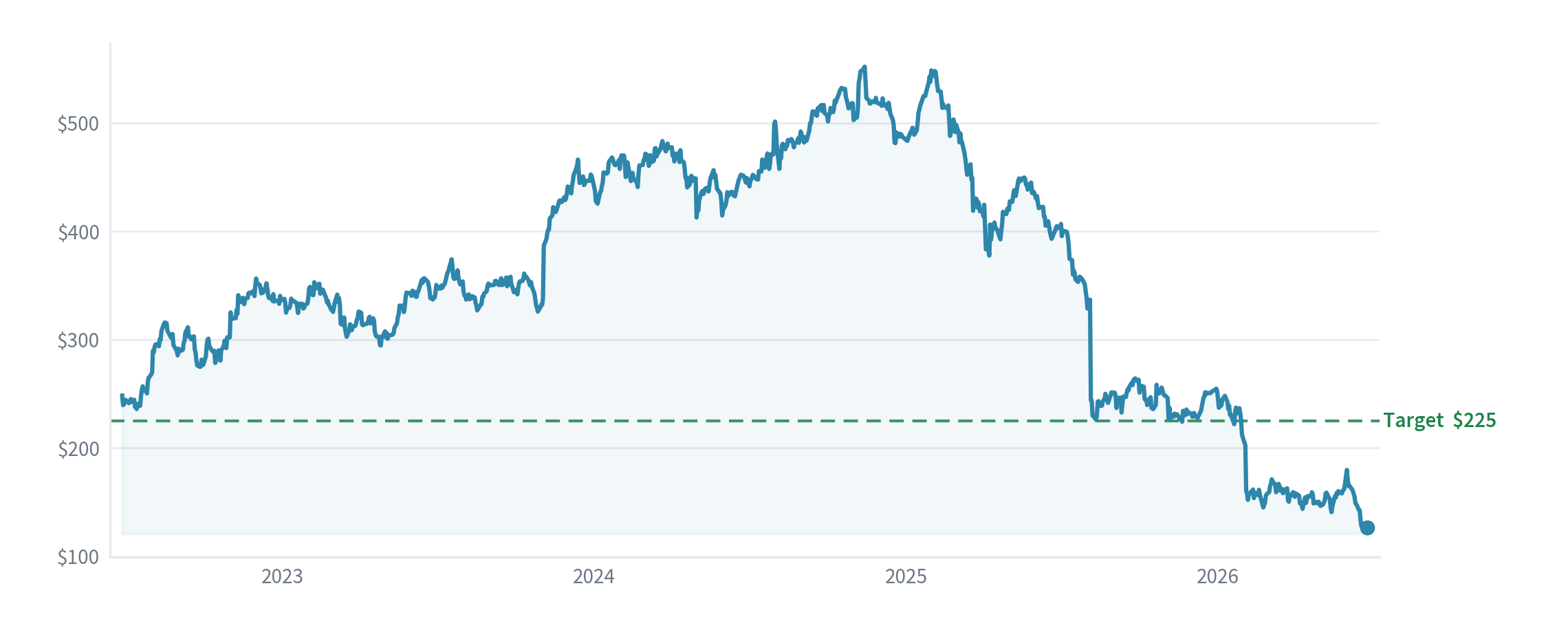
A high-quality, cash-rich subscription business has been cut roughly 63% from its 2023 high of about $434 to about $160, on the fear that artificial intelligence will make paid human research obsolete — and the question is whether that fear is overdone or correct.
How we would trade it, in plain terms
We would not buy it yet — we would watch it. Gartner is cheap if its recent slowdown is a passing air-pocket, and a value trap if artificial intelligence is permanently eroding demand for paid human research. The company's own next big results (expected in the second half of 2026) will show which it is — and waiting for that costs us only a few months, while buying now risks real money on an unanswered question. So for now: no position. The trigger to buy is evidence — its core subscription book re-accelerating — not simply a lower price. If the shares fell to a deep-discount level (around $140) one could take a small starter, but the honest base case is to wait. We would stay out for good if the slowdown proves permanent: subscription growth stuck near zero with renewal rates slipping.
What the company does
Gartner sells research and advice to businesses, mostly by yearly subscription. A company pays an annual fee for access to Gartner's analysts, data and "who's-best" technology rankings, and renews each year. There are three parts: Research (the big subscription engine and the bulk of profit), Conferences (paid industry events) and Consulting (bespoke advisory work). The prize asset is the subscription Research business — paid up front, renewed at very high rates, and highly cash-generative.
The idea in one sentence
A high-quality, cash-rich subscription business has been cut roughly 63% from its 2023 high of about $434 to about $160, on the fear that artificial intelligence will make paid human research obsolete — and the question is whether that fear is overdone or correct.
Why it looks cheap
On the company's own raised 2026 profit guidance (about $13.25 per share) the shares at about $160 cost roughly 12 times next year's earnings — low for a business that renews 97–99% of its subscription revenue each year. The stronger gauge is cash: after all spending, Gartner generates between $1.06 billion and $1.3 billion of genuine spare cash a year, which against its ~$10.7 billion stock-market value is about a 10–12% cash return on the share price, or roughly 9–10% measured against the whole business including debt. That is high, and it is the part of the case we lean on most.
Two honest caveats. First, the company's reported accounting profit (~$729 million) fell sharply year-on-year while revenue (up ~3.7% to ~$6.5 billion) and cash did not — a gap driven by below-the-line, largely non-cash items rather than the business deteriorating; we lean on the cash figure. Second, although the buyback is real (below), management bought back stock in 2025 at an average price near $345 — about double today's — so it was a genuine return of capital but not a cheaply-timed one.
What the price is implying — our valuation model
A business is worth the spare cash it returns to owners over time, with future cash worth less than cash today. Run that backwards on Gartner: at about $160, generating $1.06–1.3 billion of spare cash a year and discounting future cash at a normal ~9%, the price implies the market expects that cash to shrink by roughly 1% every year, forever. The price does not require Gartner to grow — only that it not decline. For a 97–99%-renewal business, "slowly dying" is a demanding assumption.
Looking forward, we model three futures over five years, all built on the company's own $13.25 guidance:
| Scenario | Chance | Profit growth a year | Share worth today* | Return a year |
|---|---|---|---|---|
| Good | 25% | ~13% | ~$349 | ~ +27% |
| Middle | 45% | ~9% | ~$225 | ~ +17% |
| Bad | 30% | 0% | ~$86 | ~ −4% |
*Five-year value brought back to today's money at ~9% a year.
The middle case assumes the recent slowdown clears and subscription growth returns to mid-single digits, with the shares recovering modestly from about 12 times profit to about 17 — still well below the 25-to-35 times they fetched in 2021–2023. The good case assumes growth genuinely re-accelerates. The bad case is the one that matters: artificial intelligence does erode the willingness to pay for human research, profit goes nowhere for five years even with the buyback, and the shares stay cheap.
The honest reading: a probability blend points to roughly $215 a share, but that blend leaves out the true worst case — a world where renewals actually roll over, which is worth well below $86. Add that back and the "fair value" sits much closer to today's price. So the real picture is a fork, not a bargain: about $225 if the weakness is temporary, about $86 (or less) if it is structural — and which one is right is precisely the question still open. The model confirms the shares are cheap on optimistic assumptions; it does not settle whether this is a bargain or a value trap. That is why we wait.
What we think the market is missing — and the risk
Today's price treats Gartner as a structurally threatened business: that artificial intelligence will let companies self-serve and stop paying for human research. The number the bears point to is stark — Gartner's own 2026 IT-spending forecast is +13.5%, yet its core subscription book (Contract Value) grew only about +1%. The optimistic case is that this gap is temporary and explainable: a US-government spending air-pocket that should clear, plus softness among technology-vendor clients — not a permanent erosion of the research model. Underneath, renewal rates are still 97–99% and client usage of the product has been rising.
This is unresolved, and it is the heart of the case. If the pessimists are right — AI assistants make paid human research dispensable — then renewals roll over with a lag, growth stays stuck, and the low multiple is deserved, not cheap.
The economic backdrop
Gartner depends chiefly on the US corporate and government technology-spending cycle. A +13.5% spending backdrop is supportive in aggregate; the specific drags are US federal budget churn and weakness among technology-vendor customers. The whole case turns on whether those drags are passing or the leading edge of permanent change.
The signals we are acting on
A high free-cash-flow yield (cheap on cash) is the load-bearing strand — about a 10–12% cash return at today's price. It is reinforced by a genuine, share-shrinking buyback: Gartner bought back about $2 billion of stock in 2025 and the share count fell about 8% to roughly 67 million shares — a real return of capital, not optics that merely offset employee stock. High renewal rates are the quality guard that keeps this out of value-trap territory — provided the AI fear proves overdone.
Channel checks (what we see beyond the filings)
The non-financial signals lean cautious, so we record them plainly. Employee reviews describe company-wide layoffs through 2025–26, with staff themselves attributing the cuts to AI pressure on the research model, and the published bear case flags a reduced sales force. Set against that, the company's disclosed client-engagement measure has been rising. The tension is real — usage reportedly up, yet headcount being cut — and on balance it raises, rather than settles, the question of whether the weakness is structural.
The investor checklist
- Returns on capital and moat — strong, with a caveat. Returns on capital are high; gross margin ~69%, renewal rates 97–99%, real pricing power. The caveat: renewal is quoted as a single, undated figure, and in an AI-disruption case the direction of renewals (especially among the most AI-exposed clients) matters more than the headline level — and we do not yet have that breakdown.
- Capital allocation — good, but not cheaply timed. A real, share-reducing buyback, though executed in 2025 at roughly double today's price. Debt rose modestly to help fund it; leverage stays conservative.
- Margin of safety — only at a lower price. Cheap on cash and on earnings, but the value splits in two on the unresolved question, so today's price is not a clear discount once the worst case is included.
- Cash quality — high. Spare cash comfortably exceeds reported profit; the model collects cash up front.
- Balance sheet — sound. Modest net debt against ~$1.3 billion of annual spare cash; maturities are spread out, with no near-term refinancing wall.
- Management — credible. They beat their own margin guidance and raised this year's profit guidance — a guide-low-and-beat pattern, not over-promising.
- Insider ownership — modest (~4%); no recent open-market insider buying that would lift our conviction.
Management track record
Management has a long record of compounding and disciplined capital return; they beat their margin guidance and raised earnings guidance into a soft patch — confidence, not bravado. On the evidence to date, promise-versus-delivery reads credible.
What would make us wrong
If the AI fear is right — businesses decide AI assistants make paid human research dispensable — renewals roll over, growth stays near +1% instead of recovering, and the cheap multiple is deserved. Our channel checks (AI-attributed layoffs, a smaller sales force) already lean toward this risk, so we are explicitly not treating the optimistic story as settled.
What we are watching
- Turns constructive if the next big results show the subscription book re-accelerating (growth back toward mid-single digits outside the government drag) with renewals holding at ~97%+.
- Confirms the bear case if growth stays at ~+1% with renewals slipping below ~96%, or research-side (not just consulting) headcount keeps falling.
Sources read: Gartner's full-year 2025 results and latest earnings call; the 2024 annual report (debt and maturities); ownership data; employee-review and published bear-case commentary on AI and the sales force; 2026 sector valuation data.
Part of an open research-framework experiment — generic research, not a personal recommendation and not advice. The entry, stop and target are the framework's own tracked levels, not instructions or predictions for you. The book is hypothetical (notional money, no trades placed); capital is at risk and past or hypothetical performance is not a reliable indicator of future results. Portfolio Lab is not FCA-authorised. Disclosures & risk →