Keller Group
A genuinely cheap, well-run business that has just become financially stronger than it has been in a generation — and is buying back its own shares to prove the point.
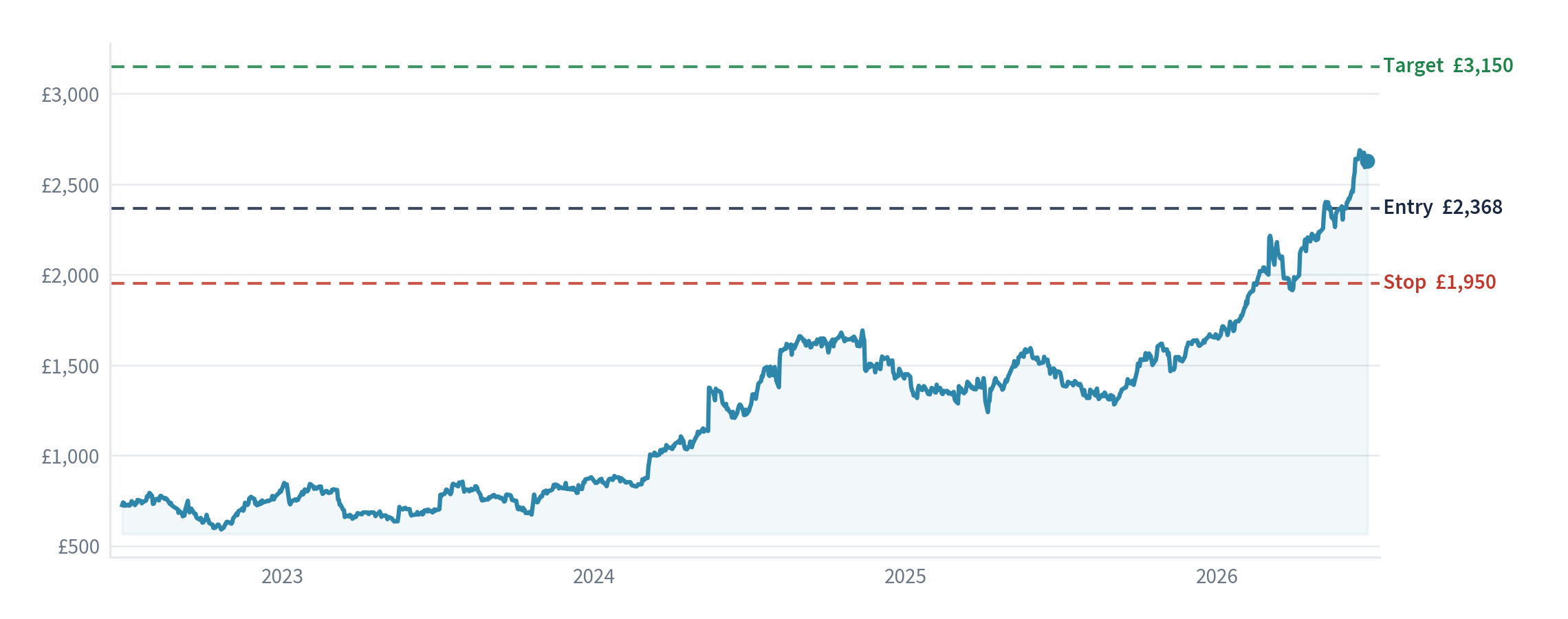
How we would trade it, in plain terms
We would buy at the next day's closing price, currently about 2,368p (£23.68) a share. We would sell and accept the loss if it fell to 1,950p, and our goal price is 3,150p. That's roughly £7.80 of potential gain against £4.20 of risk — about 1.9 times as much upside as downside. We'd expect 12–18 months, and there's a natural check-in point on 4 August 2026 when the company reports its half-year results. Confidence: 3.5 out of 5.
What the company does
Keller is the world's largest ground-engineering contractor. Before anyone builds a tower, bridge, factory or motorway, the ground underneath usually has to be prepared and strengthened — deep foundations, piling, soil stabilisation. That unglamorous but essential work is what Keller does, all over the world. It's a real, cash-generating business, not a story stock.
The idea in one sentence
A genuinely cheap, well-run business that has just become financially stronger than it has been in a generation — and is buying back its own shares to prove the point.
Why it looks cheap (with the comparison spelled out)
Using the price-to-earnings ratio — how many pounds you pay for each pound of annual profit — Keller trades at about 9.7. Every comparable UK contractor is more expensive:
- Keller: about 9.7 times
- Balfour Beatty: about 14 times
- Morgan Sindall: about 13 times
- Costain: about 11 times
So it is the cheapest of the group, on a like-for-like basis.
Why we think that cheapness is unjustified
Three things. First, it throws off real cash — about £185 million of free cash a year (the spare cash after running the business), against a stock-market value of roughly £1.6 billion. Second, it earns a high return on the money shareholders have put in (around 23% — a sign of a genuinely good business, not just a cheap one). Third, and most important, its finances have flipped to a net-cash position — more cash than debt, for the first time in about 25 years. That matters because the usual fear with contractors is that a downturn plus debt sinks them; with net cash, that fear is largely removed. On top of that, its order book is at a record level, giving good visibility of future work.
What we think the market is missing
Current pricing still treats Keller as a low-margin, boom-and-bust contractor and caps the value accordingly. We think that ignores the financial transformation (net cash), the record order book, and a clear vote of confidence from management — which brings us to the signal.
Is the work actually there? (the demand behind the order book)
This is the key question for a contractor, so we checked it. North America is Keller's biggest market — about 60% of its revenue — and in 2025 it grew about 5% even as the wider US construction market shrank 2%. In other words, Keller is winning in exactly the parts that are booming: foundations for data centres (US data-centre construction is forecast at roughly $86 billion in 2026 — the single strongest construction segment), large infrastructure projects, and the wave of reshored factories (the semiconductor/industrial build-out). Its order book of about £1.5 billion is roughly half a year's revenue already booked, which gives real visibility on hitting its numbers. The honest caveat: some data-centre and federally-funded (US infrastructure bill) projects are running late, so the demand is clearly there but the timing isn't guaranteed.
The signal we are acting on
Keller is buying back its own shares — a fresh £100 million programme, on top of a £50 million one it already completed. A company repeatedly buying its own stock when it's cheap is both a sign of confidence and a historically positive, evidence-backed signal. We track this specifically — and we checked it's real: the share count has fallen from about 72 million to 69 million, so Keller is genuinely returning cash, not just buying shares to offset new ones issued to staff.
The investor checklist (the proven-investor tests)
- Returns on capital / moat — high (about 23%); scale and track record matter in a fragmented niche.
- Use of cash — a £100m buyback that genuinely shrinks the share count (72m down to 69m).
- Margin of safety — about 9.7 times earnings versus contractor peers at 11–14 times, with net cash behind it.
- Cash quality — about £185m of free cash a year.
- Balance sheet — net cash (more cash than debt) for the first time in about 25 years.
- What others believe that we don't — they treat it as boom-and-bust; the net-cash turn and record order book de-risk that.
- Insider alignment — a company buyback rather than executives buying personally — weaker here than our insider-cluster names.
Management track record (do they do what they say?)
High — the best of our shortlist. Keller has the cleanest record of doing what it promises: 2024 beat expectations, 2025 was a record year, and the first months of 2026 came in as guided. The proof is in cash — it reached its first net-cash position in about 25 years, which is the hardest number to fake. And rather than over-promise, management actively warns when a tailwind is about to fade (it flagged that some one-off project wins and a pricing benefit wouldn't repeat) — the opposite of spin. The latest results were clearly positive: record numbers, a 41% dividend increase, and a fresh £100m buyback.
What would make us wrong
Keller is still, at heart, a cyclical contractor with thin profit margins. A serious global construction slowdown would hit it on lower volumes, and a re-rating needs the building cycle to hold up. The net-cash position cushions the downside, but it doesn't remove the cyclicality. If the shares fell to 1,950p we'd accept we were wrong.
Sources: Keller's 2026 trading update and full-year results; the £100 million buyback announcement.
Part of an open research-framework experiment — generic research, not a personal recommendation and not advice. The entry, stop and target are the framework's own tracked levels, not instructions or predictions for you. The book is hypothetical (notional money, no trades placed); capital is at risk and past or hypothetical performance is not a reliable indicator of future results. Portfolio Lab is not FCA-authorised. Disclosures & risk →