QinetiQ Group
The shares are still priced for a problem the company has already fixed, and the board is buying back its own stock at that low price.
How we would trade it, in plain terms
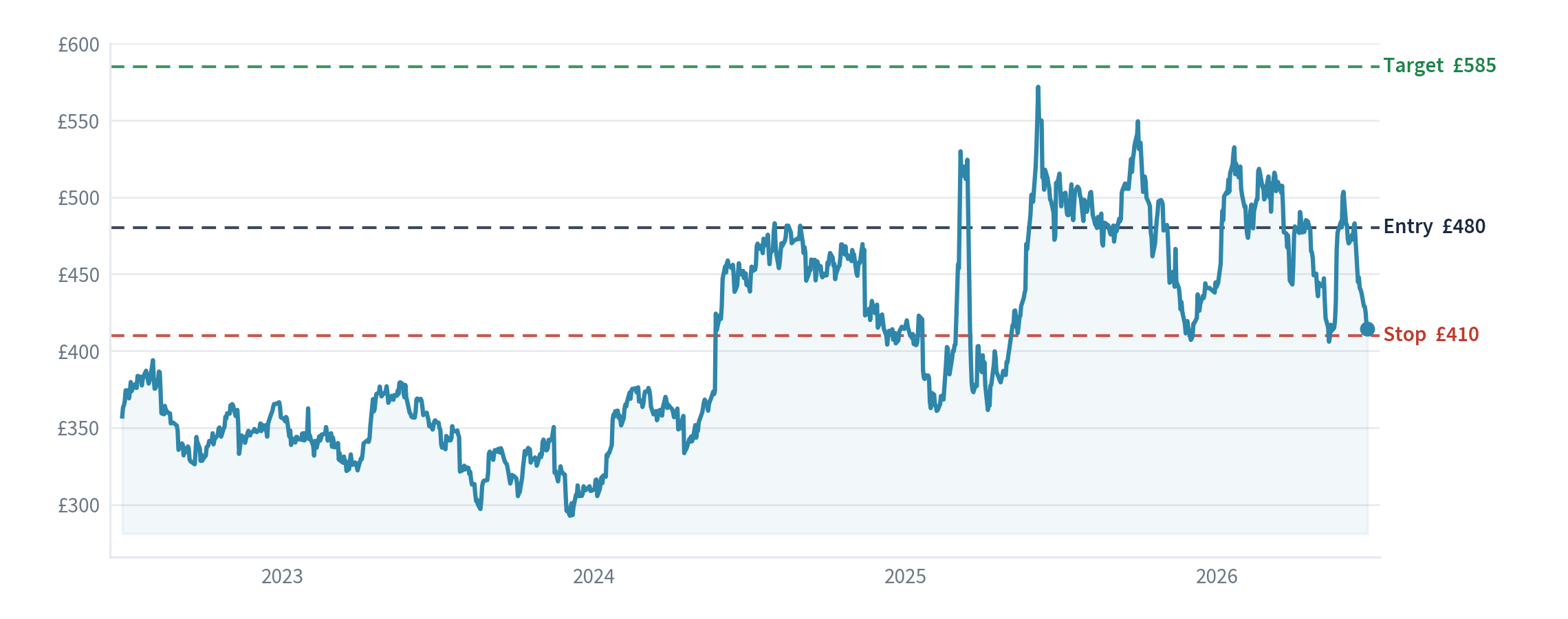
We were waiting to buy only on a pullback to 480p (using a "limit" order — an instruction to buy only at or below a set price), rather than chase the shares higher. That pullback came: we bought at 480p on 4 June 2026. We will sell and accept the loss if it falls to 410p, and our goal price is 585p — about £1.05 of potential gain against 70p of risk, roughly 1.5 times as much upside as downside, the slimmest margin on our shortlist. Confidence: 4 out of 5.
What the company does
QinetiQ is a British defence-and-security company. Rather than building weapons, it provides the "picks and shovels": it runs military test ranges, develops robotics and cyber tools, and provides training and technical advice — almost all under long-term government contracts. It's a steady, contract-based business, not a high-risk one.
The idea in one sentence
The shares are still priced for a problem the company has already fixed, and the board is buying back its own stock at that low price.
The set-back, and how big it was
In March 2025 QinetiQ warned that profits would miss expectations — government contracts were being delayed, and it took a roughly £140 million write-down. The shares fell about 20% on that news. A year on, that single event still shapes how cheaply the market values the company.
Why it looks cheap (with the comparison spelled out)
The simplest yardstick is the price-to-earnings ratio — how many pounds you pay for each pound of yearly profit. QinetiQ trades at about 13. Its UK peers are valued far more richly:
- QinetiQ: about 13 times
- BAE Systems: about 21 times
- Chemring: about 22 times
- Babcock: about 17 times
- Serco (a services peer): about 13 times
So against other British defence names it is plainly cheap — valued like a struggling services firm rather than a recovering defence supplier.
What we think the market is missing
The results for the year to March 2026 show the bad patch is behind it. Operating profit rose 18% to £218 million; the genuine spare cash the business generated ("free cash flow") rose 41% to £159 million; the order book hit a record £4.8 billion — and crucially it won more new orders than it booked in sales, which points to growth ahead. Borrowing is very low (about half a year's profit) and the dividend rose 24%. In short, the numbers have reversed, but the share price has only partly caught up. (We were honest that the shares had already bounced from about 419p just before those results to around 500p, so a good chunk of the easy recovery was already in the price — which is why we waited for our 480p entry rather than chasing.)
Is it positioned for where defence money is going? (the Ukraine question)
Yes — and this strengthens the recovery case. The war in Ukraine has pushed defence priorities toward drones, counter-drone systems, autonomy, electronic warfare and cyber, and QinetiQ sits right in those areas. It runs DroneWorks — a facility set up specifically to get drones and counter-drone kit into service at pace, in direct response to Ukraine and the UK's Strategic Defence Review — makes the Obsidian counter-drone system, and won a $41m US Army counter-drone contract in 2025, alongside its broader autonomy, electronic-warfare, secure-comms and test-and-evaluation work. The money behind this is large and growing: UK defence spending is rising about £11bn a year, with at least 10% of the budget ringfenced for emerging technology (drones and AI); European spending grew roughly 20% in both 2024 and 2025; and NATO members have agreed to head toward 5% of GDP. So the demand backdrop clearly supports the recovery and the record order book.
The honest caveat: QinetiQ is a services, testing and technology supplier — not a maker of munitions or platforms — so it rides the autonomy / electronic-warfare / cyber / testing slice of this wave rather than the raw hardware volume (which flows to the likes of BAE Systems). And as the 2025 profit warning showed, the real risk is timing — getting contracts awarded and converted — not whether the demand exists.
The signal we are acting on
The board extended its share buyback programme by £200 million. A company buying its own shares when they're cheap is both a vote of confidence by the people who know it best and a historically positive, evidence-backed sign — especially when paired, as here, with a recovery the actual numbers confirm. We also checked that it's a genuine buyback: the share count fell from about 576 million to 550 million in the past year, so the company is really shrinking, not just buying shares to cancel out new ones given to staff.
The investor checklist (the proven-investor tests)
- Returns on capital / moat — good (about 18%); long government contracts and security accreditations are a real barrier.
- Use of cash — a £200m buyback that genuinely shrinks the share count (576m down to 550m).
- Margin of safety — cheap (about 13 times) versus UK defence peers at 17–22 times.
- Cash quality — free cash up 41% to £159m.
- Balance sheet — very low debt (about half a year's profit).
- What others believe that we don't — they still price the 2025 warning; the latest numbers say it's fixed (caveat: much of the easy bounce is already in the price).
- Insider alignment — a company buyback rather than executives buying personally — weaker here than our insider-cluster names.
Management track record (do they do what they say?)
Medium, improving — and this is the reassuring part. In March 2025 they issued a painful profit warning (the shares fell ~20%), but they set out a precise recovery plan: about 3% sales growth, ~11% margin, and 15–20% earnings growth for the year to March 2026. They then delivered every line of it, and beat slightly on profit. They are also openly dealing with the weaker US arm through a strategic review rather than hiding it. It's only "medium" because the original miss was large and partly self-inflicted — but warning honestly and then hitting the promised recovery is exactly the behaviour we want to see.
What would make us wrong
The recovery depends on government contracts arriving on schedule — the very thing that went wrong in 2025. If those delays return, the record order book won't turn into revenue. There's also a review under way of its weaker American arm, which could disappoint rather than unlock value. If the shares fell to 410p we would accept we were wrong.
Sources: QinetiQ's results for the year to 31 March 2026; the £200 million buyback announcement.
Part of an open research-framework experiment — generic research, not a personal recommendation and not advice. The entry, stop and target are the framework's own tracked levels, not instructions or predictions for you. The book is hypothetical (notional money, no trades placed); capital is at risk and past or hypothetical performance is not a reliable indicator of future results. Portfolio Lab is not FCA-authorised. Disclosures & risk →