Solventum
A steady, cash-generative healthcare-supplies business was spun out of 3M loaded with debt and written off as a no-growth cast-off — but it is now growing again, widening its margins, and using a large disposal to pay that debt down, and the share price hasn't caught up.
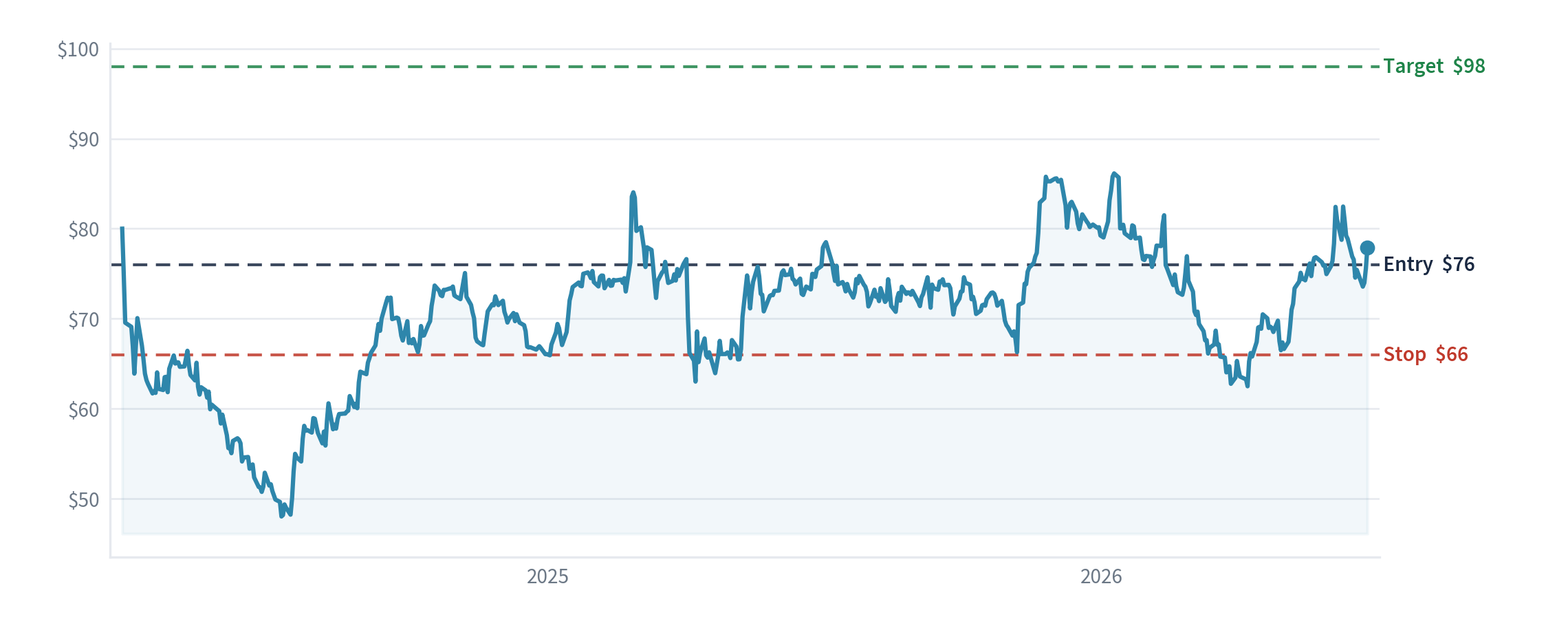
How we would trade it, in plain terms
We would buy at the next day's closing price, about $76 a share, sell and take the loss if it fell to $66 (our "stop" — the line that says the idea isn't working), and aim for $98 over 12–18 months. That means risking about $10 a share to try to make about $22 — a little over two-to-one. Confidence: 3 out of 5, held back deliberately, because this is a company still carrying a lot of debt and still proving its turnaround.
What the company does
Solventum makes the unglamorous-but-essential supplies that hospitals, dentists and health systems use every day. It has three parts: MedSurg (wound dressings, surgical supplies and infection prevention — about $1.2bn of sales a quarter), Dental Solutions (the materials dentists use for fillings, crowns and braces), and Health Information Systems (software hospitals use to code and bill their work correctly). Most of this is repeat-purchase, consumable, built-into-the-workflow revenue: a hospital doesn't switch its wound-care or coding system on a whim.
The idea in one sentence
A steady, cash-generative healthcare-supplies business was spun out of 3M loaded with debt and written off as a no-growth cast-off — but it is now growing again, widening its margins, and using a large disposal to pay that debt down, and the share price hasn't caught up.
How shares like this usually behave
Here is our starting point. A business carved out of a larger parent is often an orphan at first — index funds and the parent's shareholders sell it mechanically, and fresh standalone management has new reason to fix what the parent neglected. De-levering spin-offs that actually execute tend to re-rate higher. The risk in this particular case isn't the franchise — it's timing: the cash flow that pays down the debt is recovering slowly. So the odds favour us, with the pace of that cash recovery as the thing to watch.
Why it looks cheap
On the company's own 2026 profit guidance (about $6.50 of earnings per share), Solventum at about $76 trades at roughly 12 times earnings. Against comparable healthcare businesses that is at the bottom of the range: Medtronic, the large device maker, also about 12 times (the other cheap one); Zimmer Biomet about 22; Steris about 37; and the medical-device industry around 19–21. So Solventum is priced like the most unloved name in its neighbourhood, despite owning genuinely sticky franchises. The honest caveat on cash: its reported "spare cash flow" looks ugly right now (it was negative last quarter), but that is largely the one-off cost of standing itself up as an independent company after the 3M split — costs that roll off. We lean on the earnings price and the debt paydown rather than this temporarily-messy cash figure, and we say so plainly.
What today's price assumes — and what we think it's worth
We model three possible futures over the next five years. In each we grow the earnings forward, then apply the price-to-earnings ratio we'd expect at the end, to get a fair value:
| Scenario | What we assume | Fair value in 5 years |
|---|---|---|
| Bad case (1-in-4) | The operating turn stalls, growth slips back to zero, and the debt weighs on the shares | ~$65 |
| Most likely (1-in-2) | Low-single-digit growth and widening margins continue, the debt keeps falling, and the rating recovers modestly | ~$124 |
| Good case (1-in-4) | The turnaround sticks, cash flow normalises, and it re-rates toward its healthier peers | ~$175 |
Blending those three by how likely we think each is gives an expected return of about 8.2% a year, with a worst-case loss of about 15%. That downside is where the debt shows up — and it's why the conviction is 3 despite a genuinely strong set of franchises.
What we think the market is missing
The market still sees the 3M cast-off: no growth, too much debt. Three things say that picture is out of date. First, organic sales are growing again — up about 2% last quarter, across all three divisions, the sixth straight quarter of growth since the new management arrived. Second, margins are widening — gross margin has risen toward 56% as costs come out. Third, and most important, the debt is actually coming down: Solventum sold one division to Thermo Fisher for about $4.1bn (around $3.4bn after tax) and is using the proceeds mainly to repay debt, which has already begun to cut the yearly interest bill. A cheaper, less-indebted, growing business deserves a higher rating than a dying one — and that re-rating is the opportunity. The franchises behind it are stronger than the label suggests: it is number one in advanced wound care, number one in dental restoratives, and its hospital-coding software serves more than three-quarters of US hospitals — increasingly with AI-assisted coding, which makes it an AI beneficiary, not a victim.
Does the economic backdrop help or hurt?
Solventum sells into healthcare demand, which is about as steady as it gets — procedures, dental visits and hospital billing don't stop in a downturn. Two points cut the other way and we hold them honestly: it is a still-indebted company, so the direction of US interest rates matters for refinancing (falling rates help, rising rates hurt), and because it earns in US dollars, the dollar-to-pound exchange rate affects what we make in pounds. An ageing population and the digitisation of healthcare are slow tailwinds underneath it all.
Why we think there's an edge
This is a spin-off built on two independent, observable events: a real debt paydown (the disposal proceeds going to repay borrowings) and a real operating turn (six quarters of growth and widening margins). A balance-sheet event and an operating event pointing the same way is the kind of confluence we look for, not one weak signal dressed up twice. To be clear about what is not here: there is no share buyback yet (the cash is rightly going to debt first), and we make no insider-buying claim — we don't have that evidence, so we don't lean on it.
What other real-world signals show
The signals are mixed but interesting. Short-selling has risen (a growing bear bet on the slow cash recovery), but two respected long-term investors — the activist Trian and Independent Franchise Partners — are among the largest holders, which raises the possibility of a value-unlock push we hadn't first flagged. Analysts' profit forecasts sit in line with the company's own guidance. (A fuller sweep of this kind of data is still to come.)
The checklist we run every idea through
- How profitable, and how protected — sticky, consumable, workflow-embedded franchises (wound care, dental materials, hospital coding) with about 56% gross margins; the moat is the installed base and switching cost.
- What it does with its cash — currently paying down debt, the right priority for an over-borrowed spin-off; buybacks would come later. No share-count shrink yet (said honestly).
- Cushion if we're wrong — about 12 times earnings for a growing, margin-widening healthcare business, against peers at 19–37; the gap is the safety margin.
- Are the profits real cash? — reported spare cash flow is temporarily depressed by one-off separation costs; the test is whether they roll off and cash normalises higher (management says it does — we watch rather than assume).
- Is it financially solid? — this is the key risk and the key catalyst: 3M loaded it with roughly $8bn of debt at the spin; the disposal and ongoing cash are bringing it down, but it's still meaningful.
- Where we differ, and how we could lose — the market prices a no-growth, over-borrowed cast-off; we think the debt paydown, margin gains and normalising cash re-rate it. We lose if the turn stalls or rates bite before the debt is down.
- Are managers aligned with shareholders? — turnaround-focused management incentivised on the recovery; no insider-buying claim is made.
Management: do they do what they say?
A capable turnaround team, on a short record. Chief executive Bryan Hanson is a 33-year medical-devices veteran who turned around Zimmer Biomet and has deep experience splitting and integrating businesses — the right operator for a debt-laden carve-out. He set deliberately conservative targets after the spin and has largely delivered: six straight quarters of growth and guidance raised more than once, with the latest commentary specific and positive rather than vague. The honest blemishes: one slightly light quarter in 2025, and a rich (~$40m) 2024 pay packet. The pattern — under-promise, mostly deliver, own the misses — is what we want to see.
What would make us wrong
If the operating turn stalls — growth slipping back toward zero, or margin gains stopping — the cheap rating is deserved, not an opportunity. If interest rates rise while the balance sheet is still heavy, the interest bill eats into the case. And a healthcare-policy or tariff shock to hospital budgets would hit demand. Our discipline: we sell at $66 (about 13% below entry), roughly where "it's just a cheap, stuck, indebted cast-off" would be winning the argument.
What we'll watch to check we're right
- Organic growth holds around 2–3% across the divisions.
- The debt keeps falling and the interest bill with it.
- Cash flow normalises as the one-off separation costs roll off (guided toward a recovery through 2026).
- The Trian stake — whether it turns into an active push to unlock value.
- What would make us give up: growth stalling back to zero, or the cash recovery failing to materialise — either of those and we'd downgrade or drop it.
- What would make us re-check the whole case: each quarter's results and cash-flow figures, any debt refinancing, and any move by the activist holder.
Sources: Solventum's results announcements and investor call for its latest quarter and its affirmed 2026 guidance; its 2025 results and guidance raises; the sale of its Purification & Filtration division to Thermo Fisher (about $4.1bn, completed September 2025); the financial figures it files with the US regulator; recent ownership and analyst data; and market prices for Solventum and its peers (Medtronic, Zimmer Biomet, Steris). Figures are approximate and for context, not advice.
Part of an open research-framework experiment — generic research, not a personal recommendation and not advice. The entry, stop and target are the framework's own tracked levels, not instructions or predictions for you. The book is hypothetical (notional money, no trades placed); capital is at risk and past or hypothetical performance is not a reliable indicator of future results. Portfolio Lab is not FCA-authorised. Disclosures & risk →